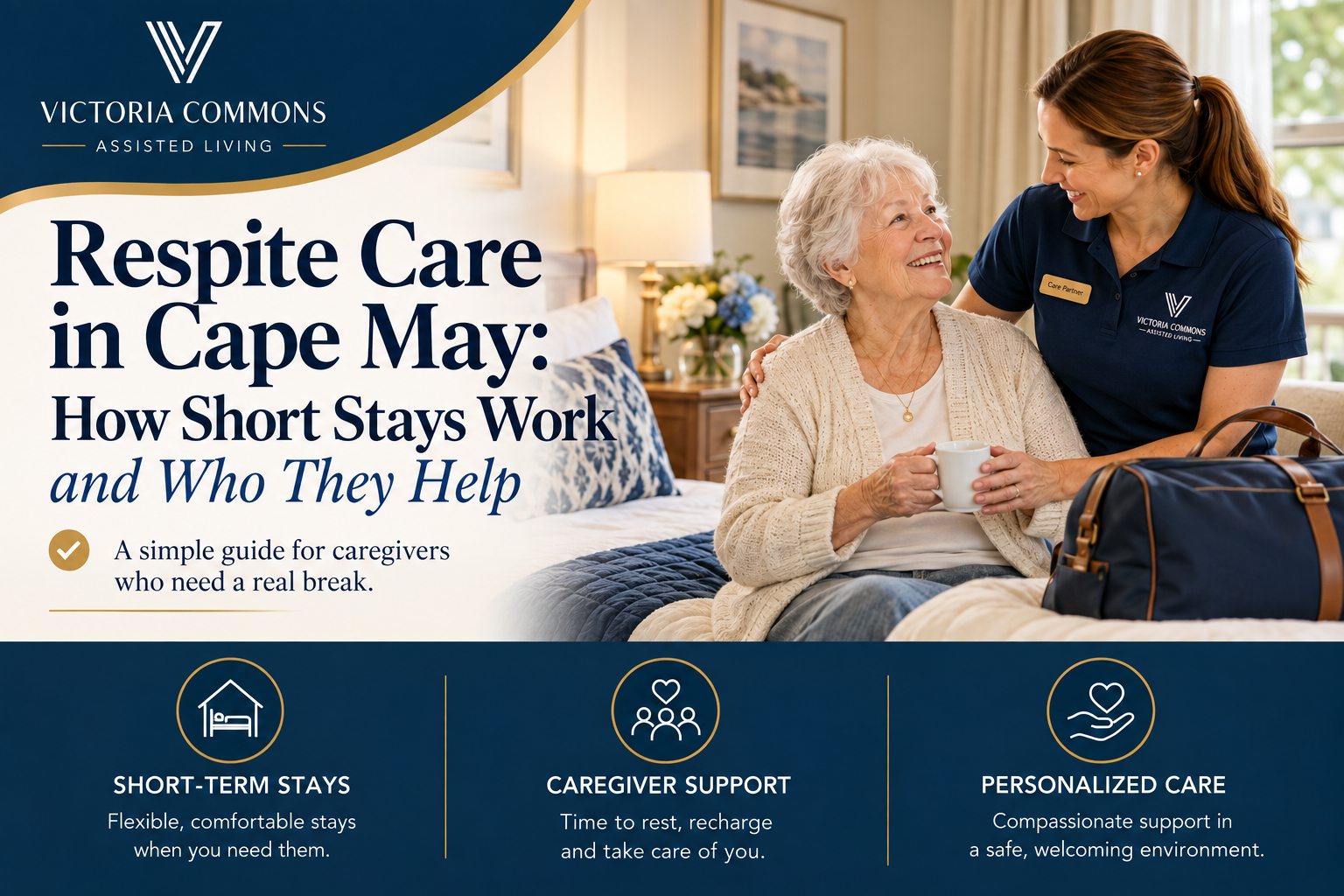
Respite Care in Cape May: How Short Stays Work and Who They Help
Written by: Miriam Landman · ✓ Medically reviewed by: Kristen Domenico, BSN, Director of Nursing · Updated September 2026
Most family caregivers we meet have not taken a real break in months, sometimes years. They skip their own doctor appointments, turn down weddings and graduations, and tell themselves they will rest once things settle down. Things rarely settle down. Respite care exists for exactly this problem, yet many Cape May County families do not know what it is, how it works, or that it can be arranged for a few days rather than a lifetime.
● QUICK ANSWER
Respite care is short term care for an older adult that gives the usual family caregiver a break. According to the National Institute on Aging, it can happen at home, at an adult day center, or in a residential setting, and it can last anywhere from a few hours to several weeks. A residential respite stay means your loved one lives temporarily in a furnished apartment at an assisted living community, with meals, help with daily activities, medication management, activities, and staff available around the clock. Families use it for vacations, work travel, a caregiver’s own surgery, recovery after a hospital stay, or as a low pressure trial before deciding on assisted living.
What respite care actually is
The National Institute on Aging describes respite care as short term relief for primary caregivers, giving them time to rest, travel, or spend time with other family and friends. The care itself can be provided at home, in a health care facility, or at an adult day center, and it may last a few hours or several weeks.
The word that matters is short. Respite is not a permanent move and it is not a decision about the future. It is a planned pause that protects the person doing the caregiving, which in turn protects the person receiving it.
The three main types of respite care
| Type | What it looks like | Best for |
|---|---|---|
| In-home respite | A paid caregiver or trusted volunteer comes to the house for a few hours | Errands, appointments, or a regular afternoon off |
| Adult day services | Supervised daytime programs with meals and activities, home again each evening | Working caregivers who need weekday coverage |
| Residential short stay | A furnished apartment in an assisted living community, with care around the clock for days or weeks | Travel, surgery, recovery, burnout, or a trial of community living |
Only the residential option covers nights, weekends, and overnight emergencies, which is why it is the one families reach for when the caregiver needs to actually leave, not just step out.
When families use a short stay
- The caregiver needs to travel. A graduation, a wedding, a family emergency out of state, or a vacation that has been postponed for three years.
- The caregiver needs medical care. A planned surgery or procedure with recovery time, when nobody else can step in at home.
- A parent is coming home from the hospital. A few weeks with meals, medication management, and help nearby can make recovery safer than going straight back to an empty house.
- The caregiver is running on empty. Exhaustion, broken sleep, and irritability are signals, not character flaws. A planned break prevents an unplanned collapse.
- The family is considering assisted living. A short stay lets a parent experience the meals, the staff, and the daily rhythm before anyone commits to anything.
- Winter on the shore. Some families arrange a stay during the quietest months, when a parent living alone faces the most isolation. We wrote about that seasonal pattern in our off season guide.
How a respite stay works at Victoria Commons
A short stay should feel simple for the family and settled for the guest. At Victoria Commons in North Cape May, the process follows four steps.
- Consultation and nursing assessment. We start with a conversation about your loved one’s needs, routines, and preferences. Our nursing team, overseen by our Director of Nursing, Kristen Domenico, BSN, then completes a health and wellness assessment covering medications, diet, and the help needed with daily activities.
- An individual care plan. The clinical team turns that assessment into a written plan covering medication, meals, personal care, and activities, so every staff member knows what your loved one needs from day one.
- Move in. Guests stay in a fully furnished private apartment. Our team helps with arrival and with settling into the common areas and routines.
- Updates while you are away. Families get regular updates and can call, visit, or join activities during the stay.
During the stay, guests receive the same support as our full time residents: staff available 24 hours a day, a 24 hour emergency call system, help with bathing, dressing, and grooming, medication management, prepared meals, and a daily calendar of activities. Our guide to what is included in assisted living walks through each of those services in more detail. You can also read more about respite care in Cape May at Victoria Commons on our service page.
Respite as a trial run for assisted living
This is the use families mention most often after the fact. A parent who would never agree to a tour will often agree to a week while a daughter travels. By the end of that week, the question is no longer abstract. They know what the food tastes like, which staff members they like, and whether they enjoyed having company at dinner.
A short stay answers the questions a tour cannot. If you are weighing the decision, our posts on the signs it may be time for assisted living and how to choose an assisted living community are good companions to a trial stay.
Respite care when a parent has memory loss
Caregivers for people living with dementia need breaks more than almost anyone, and they are often the least likely to take them. Victoria Commons supports guests with Alzheimer’s and other forms of dementia through individualized care plans and a structured daily routine, which helps reduce the disorientation a change of setting can bring.
One honest note: our secured memory care wing is currently being renovated, so availability for guests who need high acuity memory care is limited until it reopens. Call us to talk through your loved one’s needs before you plan a stay. For help deciding which level of care fits, see assisted living vs. memory care.
Who pays for respite care
Coverage is limited, so it helps to know the rules before you plan.
- Private health insurance generally does not cover respite care, according to the National Institute on Aging.
- Long term care insurance may cover respite stays under some policies. Check the policy wording and ask the insurer before the stay.
- Medicare does not cover ordinary respite stays. The exception is hospice: for a person receiving Medicare hospice care, Medicare covers inpatient respite in an approved facility for up to five days at a time, arranged by the hospice provider.
- The New Jersey Statewide Respite Care Program helps unpaid family caregivers of functionally impaired New Jersey residents pay for respite, on a sliding scale based on income. People already enrolled in MLTSS or certain other state programs are not eligible. To apply in Cape May County, call the Aging and Disability Resource Connection at 1-877-222-3737 or the county Department of Aging and Disability Services at 609-886-2784.
If long term care funding is part of your planning, our guide to whether Medicaid pays for assisted living in New Jersey covers the MLTSS program in detail.
How to prepare for a respite stay
- A current medication list with doses and times, plus any orders from the physician
- Insurance and Medicare cards, and contact details for doctors and the pharmacy
- Clothing for the full stay, labeled with your loved one’s name
- A few familiar things: family photos, a favorite blanket, a regular book or puzzle
- A short note on daily routines, such as wake time, favorite foods, and what helps on a hard evening
- Phone numbers for everyone the staff should call, in order
Book ahead when you can. Summer weekends and the holidays tend to be the busiest times for families on the shore.
Frequently asked questions
Respite care is short term care for an older adult that gives the usual family caregiver a break. It can be provided at home, at an adult day center, or in a residential setting such as an assisted living community, and it can last from a few hours to several weeks.
According to the National Institute on Aging, respite care can last anywhere from a few hours to several weeks. A residential respite stay at an assisted living community typically runs from several days to a few weeks, depending on the family’s needs and the community’s availability.
Guests stay in a fully furnished private apartment and receive the same support as full time residents: staff available 24 hours a day, a 24 hour emergency call system, help with bathing, dressing, and grooming, medication management, prepared meals, and daily activities. Every stay begins with a nursing assessment and an individual care plan.
Medicare does not cover ordinary respite stays. For a person receiving Medicare hospice care, Medicare covers inpatient respite in an approved facility for up to five days at a time, arranged by the hospice provider. Some long term care insurance policies cover respite, and New Jersey’s Statewide Respite Care Program helps eligible unpaid caregivers on a sliding scale.
Yes. Many families use a short stay to let a parent experience the meals, staff, and daily routine of a community before making any long term decision. There is no obligation to stay on afterward.
Related reading
Plan a short stay in North Cape May
Victoria Commons is a family owned assisted living community at 610 Town Bank Road in North Cape May, licensed by the New Jersey Department of Health under License #206100 and recognized with the AHCA and NCAL National Bronze Award for Quality. We welcome respite guests from across Cape May County, including Ocean City, Wildwood, Cape May Court House, Rio Grande, and Lower Township, as well as Cumberland County. Call (609) 898-0044, contact us here, or book a tour to see the apartments and meet the team before you plan your break.
Sources and references
- National Institute on Aging, what is respite care: nia.nih.gov
- Medicare, hospice care coverage: medicare.gov
- New Jersey Division of Aging Services, Statewide Respite Care Program: nj.gov
- New Jersey Division of Aging Services, county offices on aging: nj.gov
This article is for general education only and is not a substitute for financial, legal, or medical advice. Insurance coverage and program eligibility vary, so confirm details with your insurer or the relevant agency before planning a stay.