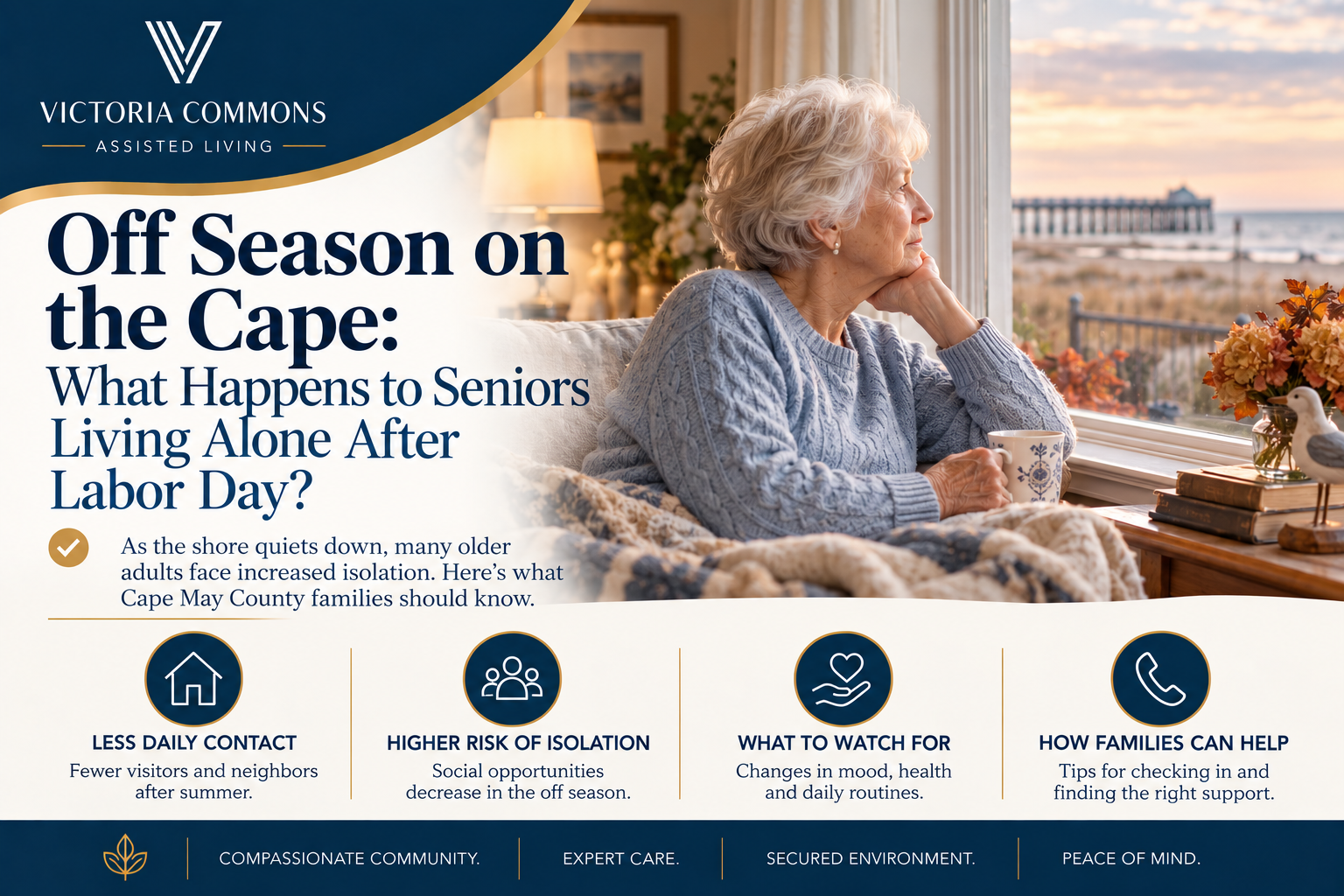
Off Season on the Cape: What Happens to Seniors Living Alone After Labor Day
Written by: Miriam Landman · ✓ Medically reviewed by: Kristen Domenico, BSN, Director of Nursing · Updated September 2026
Anyone who has lived at the shore through a full year knows the feeling. Sometime in the second half of September, the traffic thins, the rentals empty, half the restaurants post their winter hours, and the beach towns exhale. For most of us that is a relief. For an older neighbor living alone, it is the start of the hardest seven months of the year, and it happens so gradually that families who visit at Thanksgiving are often the first to notice something has changed.
● QUICK ANSWER
Summer provides older shore residents with contact they do not have to work for: family visiting, neighbors on porches, open businesses, and constant activity. When that disappears after Labor Day, seniors living alone can go from incidental daily contact to genuine isolation within weeks, and the change is easy to miss from a distance. This matters medically, not just emotionally. The National Institute on Aging reports that socially isolated older adults tend to be less healthy, have longer hospital stays, are readmitted more often, and face higher risks of heart disease, depression, and cognitive decline. Families can counter it with a fixed contact schedule, transportation arranged before it is needed, and honest attention during the first holiday visit.
What actually changes on the Cape in October
The seasonal swing here is unlike most of the country. A few specifics matter more than they sound:
- Family visits drop off sharply. Adult children who came down three weekends in July may not return until Thanksgiving. The summer feels like proof that everything is fine, and that impression has to last four months.
- Neighbors leave. In many Cape May County neighborhoods, a meaningful share of houses are seasonal. A street that felt occupied in August can be mostly dark by November.
- Daily errands get harder. Businesses cut hours or close for the season, so a short familiar trip becomes a longer unfamiliar one.
- Driving gets harder faster than people admit. Sunset moves earlier, fog and coastal storms roll in, and night driving is usually the first thing an older driver quietly gives up. Once it goes, evening activities go with it.
- Weather turns confining. Wind, cold, and wet sidewalks keep people indoors, and indoors alone is the whole problem.
None of these is dramatic on its own. Together they remove nearly every unplanned social contact from an older person’s week.
Isolation is a medical issue, not just a sad one
Families tend to treat loneliness as a mood problem and prioritize accordingly, which is to say not much. The research does not support that.
According to the National Institute on Aging, adults who are lonely or socially isolated tend to be less healthy, have longer hospital stays, are readmitted to the hospital more often, and are more likely to die earlier than people with meaningful social connections. Isolation is associated with higher risk of heart disease, depression, and cognitive decline. The NIA also explains the mechanism: emotional pain activates the same stress responses as physical pain, and sustained over time that contributes to chronic inflammation and reduced immunity.
The cognitive findings are the ones that tend to get families’ attention. An NIA summary of a large scale analysis reports that feeling lonely is associated with a 31% higher risk of dementia.
Older adults are more exposed to all of this to begin with, because hearing, vision, and memory changes, reduced mobility, and the loss of friends and family all shrink the social world independent of season. Add a shore winter and the effect compounds.
The second risk nobody plans for: falls
An isolated senior and a fall risk are frequently the same person, and winter sharpens both. Falls are the leading cause of injury and injury related death among adults 65 and older, and more than 14 million older adults, about one in four, report falling each year, per CDC data. About 37% of those who fall report an injury that required medical treatment or limited their activity.
The isolation piece changes the consequences rather than the odds. A fall with someone nearby is an incident. A fall alone in a quiet off season neighborhood can become hours on the floor. If your parent lives alone, this is the winter to sort out a wearable emergency call device and to make sure at least one nearby person has a key.
Eight things Cape May County families can do this fall
- Set a fixed contact schedule now, before the clocks change. Same days, same times. Predictable contact beats spontaneous good intentions, and a missed call becomes a signal rather than a shrug.
- Recruit local eyes. A neighbor who stays year round, a friend from church, or a mail carrier who notices patterns. Ask them to call you if something seems off, and give them your number.
- Arrange transportation before driving becomes the argument. Cape May County runs Fare Free Transportation at 609-889-3700, a no cost service for seniors and residents with disabilities. Setting it up while it is optional avoids a much harder conversation later.
- Build in one standing reason to leave the house each week. County senior centers serving Lower Township, North Wildwood, and Upper Township offer meals and activities through the Cape May County Department of Aging and Disability Services at 609-886-2784.
- Check the house for winter specifically. Handrails, outdoor lighting, non slip mats, a working heating system, and clear walkways. Do it in October rather than after the first freeze.
- Look at the food situation honestly. Not whether there is food, but whether real meals are being eaten. Home delivered meals are available through the county office.
- Set up storm plans early. Coastal storms do not end with hurricane season. Make sure someone knows who checks on your parent, and that medications are not down to the last few days.
- Plan the holiday visit as an assessment, gently. You do not need a clipboard. You do need to look.
What to look for during your first holiday visit
The Thanksgiving visit is when most families discover what the last few months actually held. The National Institute on Aging suggests looking at specific, concrete things rather than asking a parent how they are doing, since a short phone call is easy to manage well even when daily life is not.
Worth noticing:
- Is the house maintained the way it used to be, or is clutter and mail accumulating?
- Is your parent bathing regularly and dressed appropriately for the weather?
- Are medications organized, current, and actually being taken?
- Is there real food, and evidence that real meals happen?
- Has weight changed noticeably since the summer?
- Are there unexplained bruises or new hesitation on stairs?
- Has the phone stopped ringing, and have the names you used to hear about disappeared from conversation?
One sign is worth watching without alarm. Several together, particularly after a winter alone, are worth a call to the doctor. Our post on the 12 signs it may be time for assisted living goes through them in detail.
When more support is the honest answer
Every suggestion above is designed to keep a parent safely at home, which is what most older adults want and what most families should try first. But there is a point at which propping up a house in an emptying neighborhood becomes harder on everyone than the alternative, and recognizing it is not giving up.
Community living solves the off season problem structurally rather than through effort. Meals happen whether or not anyone feels like cooking. There are people in the building on a February Tuesday. Staff are on site overnight, so a fall is a response rather than a wait. Assisted living at Victoria Commons is single level, minutes from the Cape May ferry, and residents keep their own routines, furniture, and physicians.
Families who are not ready to decide often use a short respite stay over the winter months, then revisit the question in the spring with real information rather than worry. If memory changes are part of the picture, our comparison of assisted living and memory care explains where the line sits.
Frequently asked questions
Summer supplies constant unplanned contact through family visits, seasonal neighbors, open businesses, and activity. After Labor Day that contact disappears, daylight shortens, weather confines people indoors, and night driving often stops. An older adult living alone can lose nearly all routine social contact within a few weeks, and the change is difficult to detect from a distance.
Yes. The National Institute on Aging reports that lonely or socially isolated adults tend to be less healthy, have longer hospital stays, are readmitted more often, and are more likely to die earlier than people with strong social connections, with higher risks of heart disease, depression, and cognitive decline. An NIA summary of a large scale analysis links feeling lonely to a 31% higher risk of dementia.
Set a fixed schedule rather than relying on spontaneous calls, with contact at least several times a week and at consistent times, so a missed call is noticeable. Pair that with at least one local person who sees your parent in person regularly and has your phone number.
Look at concrete things rather than asking how things are going: household upkeep, mail and clutter, hygiene and appropriate clothing, whether medications are current and organized, whether real meals are happening, weight change since summer, unexplained bruises, and whether the names of friends have disappeared from conversation.
Cape May County Fare Free Transportation at 609-889-3700 provides no cost rides for seniors and residents with disabilities. The Cape May County Department of Aging and Disability Services at 609-886-2784 arranges senior center programs, congregate and home delivered meals, in home support, and caregiver assistance.
Related reading
Talk to us before the winter, not after it
Victoria Commons is a family owned assisted living community at 610 Town Bank Road in North Cape May, licensed by the New Jersey Department of Health under License #206100 and recognized with the AHCA and NCAL National Bronze Award for Quality. We serve families throughout Cape May County, including Ocean City, Wildwood, Cape May Court House, Rio Grande, and Lower Township. If you are worried about a parent heading into the off season alone, call (609) 898-0044, contact us here, or book a tour. Even a conversation helps, and we will tell you honestly if staying home is still the right answer.
Sources and references
- National Institute on Aging, loneliness and social isolation: nia.nih.gov
- National Institute on Aging, loneliness linked to dementia risk: nia.nih.gov
- National Institute on Aging, does an older adult in your life need help: nia.nih.gov
- Centers for Disease Control and Prevention, older adult falls data: cdc.gov
- Cape May County, Fare Free Transportation: capemaycountynj.gov
- New Jersey Division of Aging Services, county offices on aging: nj.gov
This article is for general education only and is not a substitute for financial, legal, or medical advice. If you are concerned about an older adult’s physical or mental health, contact their physician. If someone expresses hopelessness or that they have no reason to live, call or text the 988 Suicide and Crisis Lifeline.