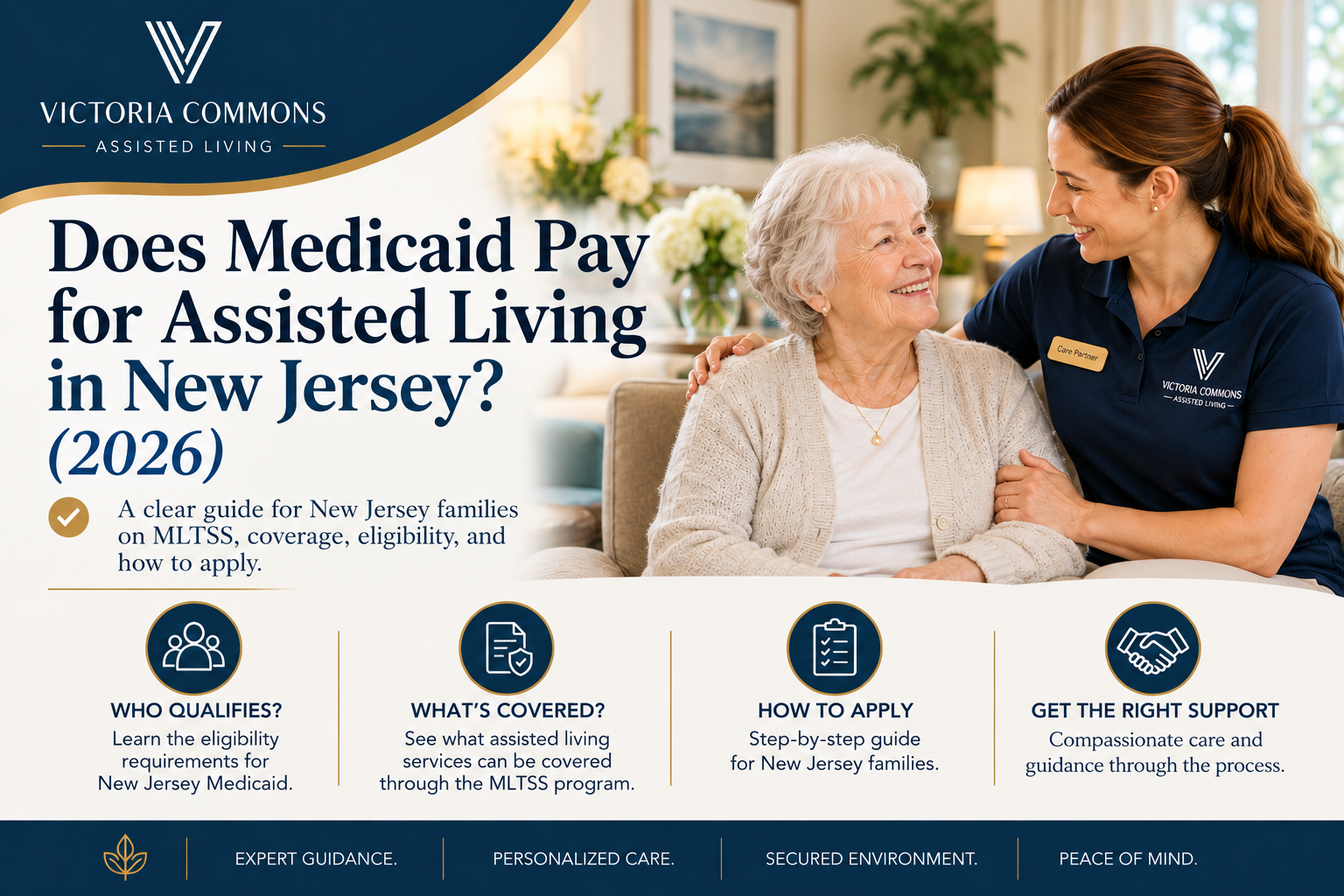
Does Medicaid Pay for Assisted Living in New Jersey?
Written by: Miriam Landman · ✓ Medically reviewed by: Kristen Domenico, BSN, Director of Nursing · Updated September 2026
This is one of the most common questions families ask us, and the answer families usually hear elsewhere is a shrug. The real answer is yes, with conditions worth understanding well before you need them. New Jersey is one of the states where Medicaid genuinely does help pay for assisted living, through a program most families have never heard of until someone finally explains it.
● QUICK ANSWER
Yes. New Jersey Medicaid can pay for assisted living care through Managed Long Term Services and Supports, known as MLTSS, which delivers long term care benefits through NJ FamilyCare managed care plans. MLTSS explicitly covers assisted living, along with home based care, adult day services, and nursing home care. To qualify, a person must meet clinical criteria, meaning hands on help with at least three activities of daily living, or cognitive deficits requiring supervision with at least three, and separate financial criteria for income and assets. Cape May County families begin the process by calling the county Department of Aging and Disability Services at 609-886-2784 for clinical screening. Not every community accepts MLTSS, so confirm participation before you plan around it.
Medicare and Medicaid are not the same thing
Almost every family confuses these two, and the distinction decides everything that follows.
Medicare is health insurance tied to age or disability. It pays for doctors, hospital stays, and short term skilled nursing rehabilitation after a qualifying hospital admission. Medicare does not pay for long term care, including assisted living room, board, or custodial help with daily activities. That remains true no matter how long someone has paid into the system.
Medicaid, known in New Jersey as NJ FamilyCare, is needs based coverage. It is the program that can pay for long term care, and in New Jersey it reaches assisted living through MLTSS.
What MLTSS actually covers
Managed Long Term Services and Supports is administered by the New Jersey Division of Medical Assistance and Health Services. Rather than paying providers directly, the state routes long term care benefits through NJ FamilyCare managed care plans, which coordinate all services for the member.
The program covers a wider range than most families expect:
- Assisted living and community residential services
- Nursing home care
- Care management, meaning a coordinator assigned to the member
- Home delivered meals and personal emergency response systems
- Home and vehicle modifications
- Respite for family caregivers
- Mental health and addiction services
- All standard NJ FamilyCare Plan A benefits
One practical point families should raise early with the county office: MLTSS pays for the care and services side of assisted living, and residents are generally expected to contribute toward room and board from their own income. Ask the county screener exactly how that works in your parent’s situation, because the arithmetic differs from household to household.
Who qualifies: the three tests
New Jersey applies three separate eligibility tests, and an applicant has to satisfy all of them.
| Test | What New Jersey requires |
|---|---|
| Clinical | Age 21 and older: hands-on assistance with three or more activities of daily living such as bathing, dressing, toileting, locomotion, transfers, eating, or bed mobility. Cognitive deficits requiring supervision and cueing with three or more of those activities also qualify. |
| Financial | Limits on monthly income and total liquid assets. Thresholds are set by the state and change, so confirm current figures with the county office or an elder law attorney rather than relying on any number you read online. |
| Age or disability | Age 65 or older, or under 65 and determined blind or disabled by the Social Security Administration or the State of New Jersey. |
The clinical test is the one families misjudge most often. Needing help with three activities of daily living is a meaningful threshold. A parent who is forgetful but still bathes, dresses, and moves independently will often not meet it yet, even when the family is genuinely struggling. Our guide to the signs it may be time for assisted living covers what those daily activities look like in practice.
How Cape May County families apply
For applicants 21 and older, New Jersey routes the process through the county Area Agency on Aging and Aging and Disability Resource Connection. In Cape May County that is the Department of Aging and Disability Services, 609-886-2784, at 3801 Route 9 South, Unit 4 in Rio Grande.
A realistic sequence looks like this:
- Call the county office and ask to be screened for MLTSS. This is the official front door, and it is free.
- Complete the clinical assessment. Clinical eligibility is determined through the New Jersey Division of Aging Services.
- Apply financially through the county board of social services. Many families use an elder law attorney at this stage, particularly where a house or spousal assets are involved.
- Enroll in a managed care plan, which assigns a care manager to coordinate services.
- Confirm the community participates. This step is skipped constantly and causes real heartbreak. Not every assisted living community accepts MLTSS, and those that do may have a limited number of Medicaid supported apartments.
Start earlier than feels necessary. Financial eligibility in particular involves documentation that takes time to assemble, and the process does not speed up because a hospital discharge is pending.
If your parent is coming out of a hospital or rehab
This scenario is common on the shore, especially after a fall. Short term rehabilitation in a nursing facility is a standard NJ FamilyCare Plan A benefit. Once rehabilitation is finished, the managed care organization screens the member to evaluate whether they meet MLTSS criteria for ongoing long term care, with clinical eligibility determined through the Division of Aging Services.
The useful thing to know is that this is a decision point, not a one way door. If daily skilled nursing care is no longer required, many people move from a nursing facility into assisted living and get a substantially more independent life. We cover that comparison in assisted living vs. nursing home.
What if you do not qualify for Medicaid
Before you rely on any of this, verify the license
Most families we meet fall into the gap: too much in assets for Medicaid, not enough income to feel comfortable about private pay. Several options exist between those poles.
- Long term care insurance. If a policy exists, it typically reimburses licensed assisted living. Ask the community for its license details and daily rate documentation to support the claim.
- VA Aid and Attendance. Wartime veterans and surviving spouses who need help with daily activities may qualify for a pension supplement. Current rates are published by the Department of Veterans Affairs.
- Jersey Assistance for Community Caregiving, which funds in home services for older adults who are not yet Medicaid eligible.
- NJSave, a single application that screens for Medicare premium assistance, prescription savings, and other cost of living help.
- PACE, the Program of All Inclusive Care for the Elderly, which operates in parts of the state.
- Proceeds from a home sale, often bridged with a short term loan while the sale completes.
Medicaid participation is a separate question from licensing, and both matter. Assisted living residences in New Jersey are licensed and inspected by the New Jersey Department of Health. Ask any community for its license number early. Victoria Commons operates under NJ Department of Health License #206100.
For the rest of the vetting process, including the contract clauses families most often regret skipping, see how to choose an assisted living community.
Frequently asked questions
Yes. New Jersey Medicaid can cover assisted living care through the Managed Long Term Services and Supports program, known as MLTSS, which delivers long term care benefits through NJ FamilyCare managed care plans. MLTSS explicitly covers assisted living alongside home based care, adult day services, and nursing home care.
An applicant must meet three tests. Clinically, a person 21 or older needs hands on assistance with three or more activities of daily living, or cognitive deficits requiring supervision and cueing with three or more. Financially, income and liquid assets must fall within state limits. The applicant must also be 65 or older, or under 65 and determined blind or disabled by the Social Security Administration or the State of New Jersey.
Start by calling the Cape May County Department of Aging and Disability Services at 609-886-2784 to request MLTSS screening. Clinical eligibility is determined through the New Jersey Division of Aging Services, and financial eligibility is handled through the county board of social services. Once approved, the member enrolls in a managed care plan that assigns a care manager.
No. Medicare does not cover assisted living room, board, or custodial care. It pays for doctor visits, hospital care, and short term skilled nursing rehabilitation following a qualifying hospital stay, and it continues to cover regular medical care wherever a person lives.
No. Participation is voluntary, and communities that do accept MLTSS may offer a limited number of Medicaid supported apartments. Always confirm a specific community’s participation and current availability before building a plan around it.
Related reading
Talk through the options with our team
Victoria Commons is a family owned assisted living community at 610 Town Bank Road in North Cape May, licensed by the New Jersey Department of Health and serving families throughout Cape May County, including Ocean City, Wildwood, Cape May Court House, Rio Grande, and Lower Township. If you are working through how care might be funded, call (609) 898-0044 or contact us here. You are also welcome to book a tour and see assisted living at Victoria Commons firsthand.
Sources and references
- New Jersey Division of Medical Assistance and Health Services, Managed Long Term Services and Supports: nj.gov
- New Jersey Division of Aging Services, county offices on aging directory: nj.gov
- New Jersey Department of Health, licensed health care facilities: nj.gov
- Medicare, long term care coverage: medicare.gov
- US Department of Veterans Affairs, veterans pension rates: va.gov
This article is for general education only and is not a substitute for financial, legal, or medical advice. Medicaid eligibility rules and financial thresholds change, and individual circumstances vary widely. Confirm current requirements with the Cape May County Department of Aging and Disability Services or a New Jersey elder law attorney.