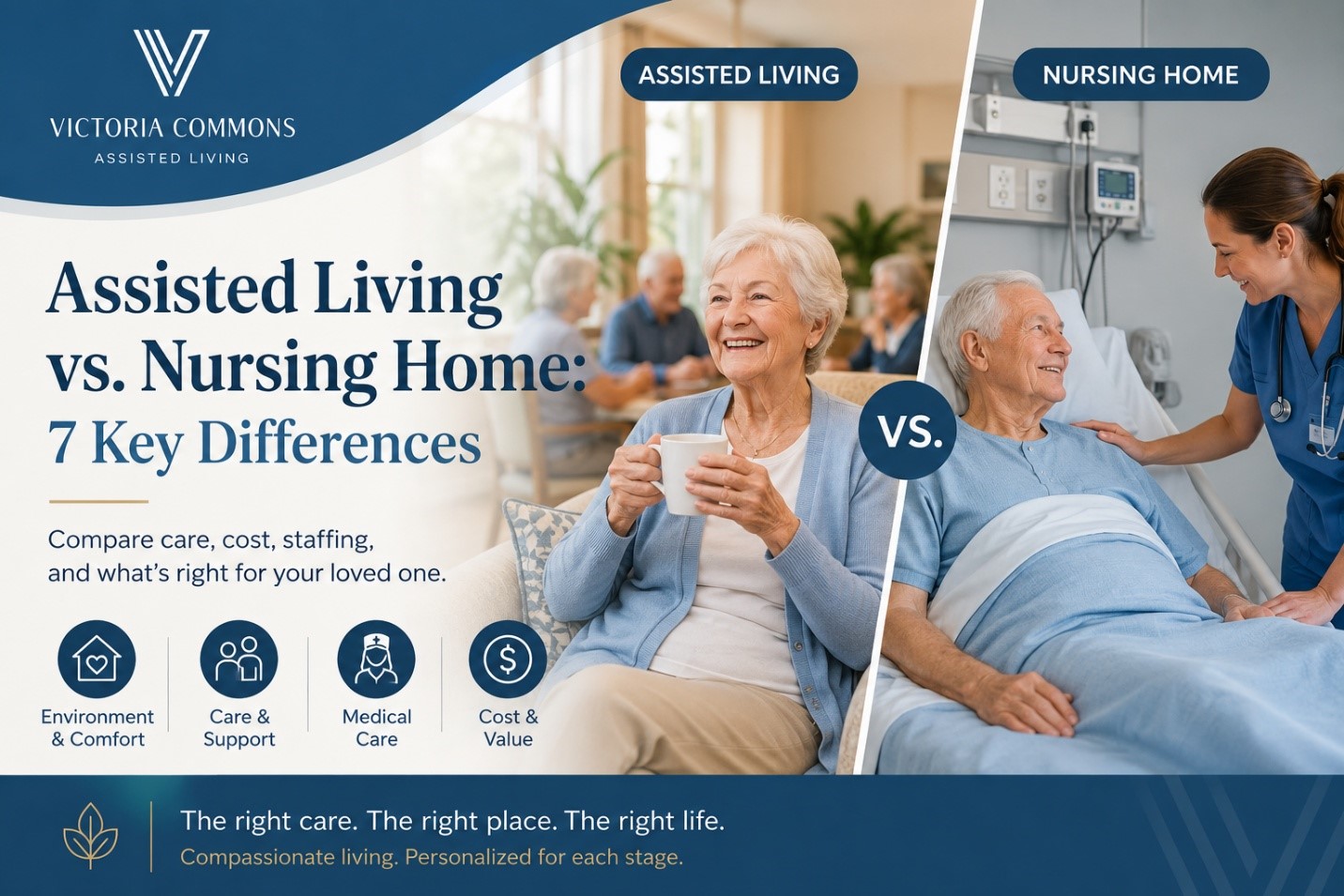
Assisted Living vs. Nursing Home: What's the Difference?
Choosing between assisted living and a nursing home is one of the most important decisions a family makes — and one of the most confusing. Both provide care for older adults, but they serve very different needs, offer very different environments, and cost very different amounts. This guide explains the real differences so you can match the right level of care to your loved one's situation.
Assisted living provides housing and hands-on help with daily activities such as bathing, dressing, meals, and medication management for seniors who are medically stable. A nursing home (skilled nursing facility) provides 24/7 medical and nursing care for people with complex health conditions. Most older adults who need daily help but not daily medical treatment are best served by assisted living; nursing homes are for skilled care needs like wound care, IV therapy, or post-hospital rehabilitation.
- Assisted living = residential setting, personal care, 24-hour staff presence, high independence
- Nursing home = clinical setting, licensed nurses on duty around the clock, physician oversight
- In New Jersey, a semi-private nursing home room costs about 51% more per year than assisted living (median $153,300 vs. $101,550)
- Medicare pays for neither long-term — it covers only short-term skilled nursing rehab after a qualifying hospital stay
- Both are licensed and inspected by the NJ Department of Health
What is assisted living?
Assisted living is a licensed residential care setting for older adults who need help with activities of daily living (ADLs): bathing, dressing, eating, mobility, and managing medications, but who don't require daily medical treatment. Residents live in private suites, eat meals together, follow their own routines, and have trained staff available 24 hours a day.
The typical assisted living resident is someone who was struggling quietly at home: missed medications, skipped meals, a fall or a close call, growing isolation. What changes after a move is structure. They have reliable personal care, prepared meals, and daily social contact while the resident still keeps their independence, furniture, routines, and privacy.
What is a nursing home?
A nursing home, formally a skilled nursing facility (SNF), is a clinical care setting where registered and licensed practical nurses are on duty 24/7 under physician oversight. Nursing homes serve people who need daily skilled care: complex wound management, injections and IV therapy, ventilator or feeding support, or intensive rehabilitation after a hospitalization such as a stroke, surgery, or serious fall.
Two facts about nursing homes surprise many families. First, a large share of nursing home stays are short-term rehabilitation, not permanent placement. Second, a "nursing home" is not the default next step after living at home, and for most seniors who simply need daily help, it's the wrong match.
Assisted living vs. nursing home: side-by-side
| Factor | Assisted Living | Nursing Home (SNF) |
|---|---|---|
| Designed for | Help with daily activities; medically stable | Daily skilled medical/nursing care |
| Care provided | Personal care, medication management, meals, housekeeping | Wound care, IV therapy, rehab, ventilator/feeding support |
| Medical staffing | Care aides 24/7; nursing oversight | RNs/LPNs on duty 24/7; physician oversight |
| Setting & feel | Residential — private suites, dining room, activities | Clinical — hospital-style rooms, often shared |
| Daily independence | High — residents set their own schedules | Limited — routines follow clinical care |
| Typical stay | Long-term home | Often short-term rehab; some long-term |
| NJ median cost (2026) | $101,550/year | $153,300–$173,375/year |
| Medicare coverage | Not covered | Short-term rehab only (up to 100 days) |
Cost data: CareScout Cost of Care Survey 2025, based on 25,000+ provider-reported rates. New Jersey detail via CareScout's March 2026 state release.
The 7 differences that matter most
Medical care vs. personal care
This is the dividing line. If your parent needs a nurse's treatment every day, a nursing home (or short-term rehab) is appropriate. If they need a helping hand with daily life such as reliability, and safety around the clock — that's assisted living's entire purpose.
The environment shapes daily life
Assisted living is built like home: private suites, restaurant-style dining, gardens, activity calendars. Nursing homes are built like healthcare, because they are healthcare. For a senior who is largely well, environment isn't cosmetic — it drives mood, appetite, activity, and engagement.
Independence and autonomy
Assisted living residents wake, eat, host visitors, and come and go on their own schedule. Nursing home routines are organized around clinical care. The right question isn't "which is safer?" but "how much structure does this person actually need?"
Cost — and what drives it
The roughly $52,000-per-year gap between NJ assisted living and a semi-private nursing home room reflects staffing intensity: nursing homes carry round-the-clock licensed-nurse coverage that most seniors don't need. Families who default to a nursing home for non-medical reasons pay a clinical premium for care that a residential setting delivers better.
What Medicare does and doesn't pay
Medicare does not cover long-term care in either setting. It covers up to 100 days of skilled nursing rehabilitation after a qualifying hospital stay, then coverage ends. Assisted living is typically funded privately, through long-term care insurance, VA Aid & Attendance, or New Jersey's Medicaid MLTSS program.
Staffing models
Nursing homes: licensed nurses every shift, physician oversight, clinical documentation. Assisted living: trained personal-care staff 24/7 with nursing leadership — at Victoria Commons, under our Director of Nursing, Kristen Domenico, BSN, with residents keeping their own physicians.
Transitions run both directions
People move from nursing homes to assisted living more often than families expect. Typically after short-term rehab ends and daily skilled care is no longer needed. A respite stay is often the bridge between hospital discharge and a confident decision.
How to tell which one your parent needs
Assisted living fits when your parent:
- Needs help with bathing, dressing, medications, or meals — but is medically stable
- Has had a fall, weight loss, or medication errors at home
- Is isolated, and it's showing in mood, appetite, or activity
- Would benefit from 24-hour staff presence without a clinical setting
A nursing home fits when your parent:
- Requires daily skilled nursing care or intensive therapy
- Has a condition needing continuous medical monitoring
- Is leaving the hospital with complex treatment orders
Frequently asked questions
Is assisted living cheaper than a nursing home?
Yes. In New Jersey, the median nursing home cost runs $153,300–$173,375 per year versus $101,550 for assisted living — roughly $52,000–$72,000 more annually. The difference reflects 24/7 licensed medical staffing most seniors don't need.
Does Medicare pay for assisted living or a nursing home?
Medicare pays for neither as long-term care. It covers short-term skilled nursing rehabilitation — up to 100 days after a qualifying hospital stay — and continues covering regular medical care wherever a senior lives.
Can a nursing home resident move to assisted living?
Yes, and it's common after short-term rehab ends. If daily skilled care is no longer required, moving to assisted living restores independence and a residential quality of life. Ask the discharge planner for a level-of-care evaluation before assuming long-term placement.
Can assisted living handle wheelchairs, walkers, or incontinence?
Generally yes — mobility and continence support are core assisted living services. Victoria Commons is single-level by design, with no elevators or stairs anywhere a resident needs to go.
Who decides which level of care a senior needs?
A physician evaluates medical needs; the community's nursing team conducts a care assessment before any move-in. In New Jersey, both settings operate under Department of Health licensing standards that define what level of need each may serve.
Not sure which level of care your parent needs?
Victoria Commons is a family-owned assisted living community in North Cape May, NJ — licensed by the NJ Department of Health (#206100) and an AHCA/NCAL National Bronze Award recipient. We'll give you an honest read on the right fit, even if it isn't us.
Book a Tour Call (609) 898-0044Cost data: CareScout Cost of Care Survey 2025, 25,000+ provider-reported rates; NJ detail via CareScout March 2026 state release.
Medicare rules: Medicare.gov · ADLs: National Institute on Aging
This article is for general education only and is not a substitute for medical or financial advice.